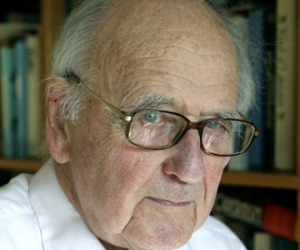
[00:00:00] BOB BERDAHL:
Good afternoon. I, uh, I’m Bob Berdahl, uh, and it’s my great pleasure to welcome you all today to, uh, the b– the Tanner Lecture for the year two thousand and one. It’s, uh, it’s a wonderful pleasure to see so many folks here.
Uh, I have to tell you that each year, uh, I– one of my responsibilities as, uh, chancellor of the campus is to report to the Tanner Foundation on these lectures, uh, and the attendance is, uh, an important consideration to the Tanner Foundation. And so it’s a, a special pleasure to look out at this, uh, packed room and this large audience, uh, and to, uh, be able to be assured that come next June when I report on this lecture, I can tell them that we had a packed crowd, uh, for this lecture. It’s also a great special privilege to welcome our lecturer, Sir Frank Kermode, as well as our three distinguished commentators, John Guillory, Geoffrey Hartman, uh, Carey Perloff, uh, to the campus for, uh, this very special occasion.
My task here today is simply to give you the background for the Tanner Lectures. The Tanner Lectures on Human Values began at Cambridge University in 1978. And since that time, permanent Tanner Lectureships have been established at Oxford, Harvard, Yale, Princeton, Stanford, and at the Universities of California, Michigan, and Utah.
Uh, and I’ll explain a little bit about the Utah connection here in a minute. The Tanner Lecture, which used to rotate among the campuses of the University of California, now resides permanently at Berkeley, and we’re delighted that this is the permanent home and that we will enjoy the Tanner Lectures here each year. The Tanner Lectures on Human Values are a gift from Obert C. and Grace Tanner, both of whom are of British ancestry and descended from early Mormon pioneers, uh, in the state of Utah.
In fact, Obert Tanner was the ninth son, uh, of his father, who had multiple wives, uh, and who actually, uh, because of polygamy, fled the United States, abandoning his family, uh, when Obert Tanner was a very young man. Uh, and as a consequence of having to work very hard himself, uh, developing strong beliefs in the value of community and hard work and respect for one’s fellow men, Obert Tanner, uh, emerged as a very, very successful, uh, individual. At an early age, he was taught by his mother, he said, to regard universities as one of man’s noblest creations, and it is this belief that really, uh, informed the rest of his life.
He received his law degree from the University of Utah, and then he pursued philosophy at Harvard and Stanford universities. At Stanford, he was appointed to the faculty in religion and also served as the acting chaplain. At the University of Utah, uh, he joined the faculty in, in philosophy in 1946 and remained there as a professor emeritus until his death in 1993.
He was, however, not only an academic. Uh, in 1927, he founded the The O.C. Tanner Company, which manufactured, uh, jewelry and specialized in corporate recognition awards and became the largest firm of this kind in the United States. Uh, he described his company’s history as a search for beauty, uh, and he believed in the company’s work, uh, as a form of recognizing human labor.
Uh, he was very successful in this business, and this allowed Tanner to become a major philanthropist in the state of Utah, causing the governor of Utah at one time to describe him as the state’s most generous benefactor. He was the recipient of many honorary degrees, was decorated by the Queen of England, was was an honorary fellow in the British Academy. In nineteen eighty-eight, he was awarded the National Medal by in the Arts by President Reagan.
Uh, it was as a consequence of his success in business and his interest in the humanities and in human values that he established this lecture series. And as he said, “I hope these lectures will contribute to the intellectual and moral life of mankind. I see them simply as a search for a better understanding of human behavior and human values.
This understanding may be pursued for its own intrinsic worth,” he said, “but it may also eventually have practical consequences for the quality of personal and social life.” Today, in addressing the relationship between the canon and pleasure, between pleasure and pain and imagination, uh, Sir Frank Kermode is addressing themes that are central to the purpose of the Tanner Lectures. Indeed, central to Obert Tanner’s mission to understand better human values and behavior.
We’re indebted to Mr. Tanner and the lecturers and the commentators who are here, and especially, uh, Sir Frank for their invaluable work in making this possible. And now to introduce Sir Frank Kermode, it is my pleasure to turn the podium over to Robert Alter, who, as you all know, is the Class of nineteen thirty-seven Professor of Hebrew and Comparative Literature. Professor Alter teaches courses in the nineteenth-century European and American novel, in modernism, and on literary aspects of the Bible, and also teaches on modern Hebrew literature.
His publications range from critical biography of a critical biography of Stendhal to literary theory, two recent volumes of biblical translation accompanied by literary commentary. Uh, his most recent book is entitled The Canon and Creativity. Uh, he’s also edited a literary guide to the Bible with Sir Frank Kermode in 1987.
So he’s a very appropriate person to bring to the podium to introduce Sir Frank Kermode. Bob Alter.
(applause)
[00:07:11] ROBERT ALTER:
Thank you very much, Ch-Chancellor Berdahl. Now, uh, since y-you have in the program for this e-event, uh, the titles of some of, uh, Sir Frank Kermode’s principal publications, I’m not going to fatigue you with a long list, a-and his is a very long and also very illustrious list. I, I can’t resist starting on a personal note, whi-which is, uh, how we got to know each other.
From my point of view as a literary person, uh, it was an ideal way to get to know, uh, uh, Frank Kermode. Um, I should say that i-in addition to the more prominent elements of his, uh, publications, uh, Frank Kermode i-is a very distinguished and discerning, uh, reviewer, and he continues to review quite prolifically on both sides of the Atlantic to this day. Those of you who have published books know that, that it’s no wonderful deal to be reviewed.
I mean, my own experience is that either you’re reviewed hostilely, at, at which point you say to yourself that this man’s an idiot or this woman’s an idiot, or, um, alas, you’re reviewed rapturously and you have to say with a certain amount of embarrassment, “This person is an idiot.” So I, I won’t fill in any of the details, but, uh, ex-exactly twenty years ago, I published a book on, uh, biblical narrative, and I was getting antsy after a few weeks. Is the New York Times Book Review going to run a review?
And then lo and behold, there, there was a, an extremely intelligent review that really understood what it was all about by, uh, Frank Kermode. Uh, a few months later, uh, um, Frank Kermode had conceived the idea of putting together a large, uh, volume on, uh, th-that became, uh, the Literary Guide to the Bible. And he had already, uh, done some very interesting things, uh, on the New Testament, and he needed an Old Testament partner and got in touch with me.
Uh, it was an extremely happy collaboration. I, I, have to say that I was a little bit nervous feeling that, that I was, uh, an uncouth American, wet behind the ears, a-a-and all that. But, uh, uh, Frank Burt was an ideal collaborator.
Uh, we, we saw eye to eye. I, uh, I always felt that he treated me with great consideration. And, uh, the, the result was not bad.
A little mixed when y-you get together a bunch of, uh, contributors, but, but on the whole, we were, uh, pleased with what we did. W-when I think of Frank, uh, Frank Kermode’s career, um, I flash back to a, a, a moment when I was visiting the University of Arizona and ha-having lunch in the faculty club, a-and there was a, a youngish Frenchman there, and he sort of growled at me. He said, “I don’t have a field.
A peasant has a field. I am interested in literature.” Well, uh,
[00:10:22] BOB BERDAHL:
Yeah.
[00:10:24] ROBERT ALTER:
Uh, well, one of the, the, the reasons, uh, uh, in addition to the sheer force o-of intelligence, a kind of subtle, unforced intelligence that, that has made Sir Frank Kermode one of the leading critics in the English-speaking world for the last several, uh, decades, is his boundless curiosity, that he i-is not the peasant that’s limited to one field. He has, um, written on Shakespeare both early in his career and recently in a fi– his, his last and I think very fine book, uh, Shakespeare’s Language. Um, he, a-and he’s, he’s written, uh, more broadly on the Renaissance.
Uh, he’s written on, um, uh, the Romantics, uh, he’s written on Wallace Stevens, uh, perhaps one of his… He, he’s, i-is one of those rare people who’s actually published several seminal books. So I, I hesitate to say that his most seminal, one of his most seminal books is a reflection on how narratives end a-a-and what this has to do with the way we construct history, uh, called, uh, The Sense of an Ending, which I think goes back to, to, to, uh, the, the late ’60s.
Uh, he i-is a critic who, I think, fortunately, can’t be easily placed. That is, he was, um, open to the various waves, uh, uh, of, uh, literary theory that began to, to, to hit the rather, uh, uh, crusty bastions o-o-of Anglo-American literary studies in the late sixties. But he, he never, uh, followed any of those schools mechanically or, uh, formulaically.
A- and he was quick to see what were the limitations of these various schools w-w-without really be-be-being, uh, uh, um, um, reactively polemic a-a-against them. I, I think that, uh, uh, he is, uh, a-an eclectic critic in the very best sense o-of the word.
And, uh, what I find both in his early work and in the, the most recent things he’s done, including a splendid paper on the uses of poetry that I heard him give ten days ago, is that he has a sense of why, after all, we read literature, why it makes a difference in in our lives, and I think we will hear something of that this afternoon. It’s a great pleasure and honor for me to present, uh, Sir Frank Kermode.
(applause)
[00:13:28] SIR FRANK KERMODE:
Uh, I want to thank, uh, Robert Alter, um, the name by which I’ve always been encouraged to call him, uh, and to say I look back on that collaboration with just as much, perhaps more pleasure than he does. For one thing, uh, if you divide a book about the Bible into Old Testament and New, the person who draws the Old Testament does eighty percent of the work.
(laughter)
So I reckon that was a pretty shrewd deal, and we didn’t quarrel once about it in the whole course of it. I’m delighted, of course, to have been asked to give these, these lectures, uh, and I pe-perhaps begin by explaining that their titles are shrunken versions of the titles of Wallace Stevens’, uh, uh, sections in his poem, Notes Towards a Supreme Fiction, an old-fashioned poem which I still admire very much after forty-odd years of knowing it. Mm-hmm.
(breath)
You’ll have to forgive me,
(breath)
I’m a little short of breath today.
(breath)
Stevens wrote three sections: It must change, it must give pleasure, and it must be abstract. As I had to leave one of them out, I happily chose the one about the abstraction. Actually, But I believe in Stevens.
Well, I don’t have to believe in Stevens, that’s a ridiculous thing to say. I mean, I be– I think that, uh, “Notes Toward a Supreme Fiction” is an ex-excellent, uh, and r-very rare example of a poem about aesthetics.
And of course, some of it is about pleasure. And I’m not gonna talk about Wallace Stevens. Uh, just as on the whole today, I’m not gonna talk about Shakespeare, although the, the, uh, title of the talk might lead you to think that I was gonna do that.
Uh, somehow or other, in, in the course of its gestation, this talk pushed Shakespeare not quite out, but almost. Uh, I have to do what I can to retrieve him tomorrow. But I would say in the meantime that, uh, when you talk about canon, you are a fortiori talking about Shakespeare.
So everything that I say can, by a little bit of intellectual sleight of hand, be translated into a comment on Shakespeare. But that’s up to you, I’m afraid.
(coughs)
Uh, Robert also mentioned the controversies which we’ve all been engaged in, in one way or another. I think at my age, now that I’ve grown old, I can say that professional life involved, uh, some part in, um, many different controversies. And one of them, as it comes on both sides, was canonicity.
But I don’t see now very much helpful connection between what we talked about in the sixties and what I want to talk about now. There are two– there are two different worlds. I thought of a remark of Chateaubriand in the Mémoires d’Outre-Tombe.
“If I compare the two terrestrial globes,” he says, “the one I knew at the beginning of my life and the one I now behold at the end of it, I no longer recognize the one in the other.” I think I believe now that these globes are not really mutually recognizable or compatible. Uh, you have to choose.
As Wallace Stevens says, “This is not a choose– this is not a choice between, but of.” And I choose the old globe in my own case. It’s defined as the place where serious account is still taken of what happens in art, what happens in sensations sweet, if you like, felt in the blood and felt along the heart?
Sensations still accessible, though doubtless with more difficulty, and as one ages, reduced perhaps to mere sober pleasure. There doesn’t seem to be any point any longer in deploring these differences. Uh, in the course of a generation, we have reached a moment where the discourse, as one says, of the older globe, uh, is cons– is thought by many people to be not only passé, but manifestly wrong, and perhaps even wicked, uh,
(coughs)
since it’d collaborate with various political– sent to collaborate with various political situations, which are regarded as wicked. I have known students, good students too, um, who have regarded the study of literature, uh, as the study of a totally illusory topic. Uh, in, in literature, it no longer be thought to exist, and to study it or pretend to is a sort of atavistic duty imposed by unthinking seniors, and to be got through, as in older times, one had to construe orally a chapter of the Greek New Testament before passing on to real study.
(coughs)
Under the old dispensation, you could choose between different critical methodologies, but what they had in common, I think, it was an assumption that it was possible and right to speak of literary quality and literary value. It was true that one could be taught to read, preferably to read selected texts because they were thought to be good, with a degree of attention warranted the issue of judgments, including the judgment that some works, which might, if you like, be described as canonical works, demanded to be studied by all who claimed the right to instruct others. Under the new dispensation, there are interesting ways of outlawing such preoccupations, disparaging such forms of attention, and replacing them with alternative subjects and methods deriving their force from disciplines apparently more difficult and rewarding, and in their way, more scientific.
I think that’s a point of some importance. The flourishing of the humanities in the post-war universities has largely been on the crumbs that have fallen from the table of the sciences. And the more scientific we can make our work look, the better the universities are pleased.
But if you look at the, at the issue from the other side, you might say by way of daring paradox that literary criticism, a discipline by which in the past we all set so much store, has in the end turned out not to be boring or obvious, but actually too difficult. A failure of successive critical schools and critics of acknowledged intelligence and imagination may be thought to have demonstrated this. On this view, the borrowed languages from linguistics and anthropology, psychoanalysis, and so on, exciting new ways of writing history, they proved not only more attractive, but easier to do.
Unrestricted, usually by specific texts, endowed with new and endlessly expansible lexicon. One can continually be new, which is quite important in institutional terms, rapidly acquiring fascinating fresh-minted technical terms, and one could discuss important matters that lacked any direct relationship to literature as it was formerly understood or misunderstood. There has been much commendable excitement and much, much exuberant thinking as well as much vain talk, and that I think should not be contested.
There’s been a long holiday in the graduate schools anyway, some of them, uh, from what? That sentence was not complete. There’s a bit of an article.
A long holiday from what we were… Uh, I’m not gonna get through it that easily. From, from, uh, primary texts.
Boring, I’m afraid. Uh, there’s been an increase in the intellectual range, which many people think ample compensation for what has been lost during its acquisition. The new, the new is invested with a momentary charisma, but we know what happens to charisma.
It declines if the
(coughs)
institutional. So more new is needed, new charisma generated. Meanwhile, in the graduate schools, there prevail paradigms that tend, in the nature of the case, to be always already, always already, uh, slightly out of date.
(laughter)
It would be foolish to deny that the practice of this new criticism, uh, in the hands of gifted writers has not given real pleasure. But gifted writers are no more numerous in this than in any other discipline, and the pleasure seems most often to derive more from an admiration for the arduousness of what is being done than for any genius that is exposed. But I was reading recently, as I expect many people in this room have, Frederick Crews’ new and timely book, Postmodern Pooh, and what’s so impressive about it is, I think, that passages– as I read the book, I supposed that he was making up the products of his satirical imagination and possibly a bit over the top, were actually straight quotations for which his sober footnotes provided bibliographical warrant.
You ask yourself what could possibly be the intended audience for remarks of this kind? The dissident author wants us to see it as a kind of satyagraha. Uh, but other people, of course, wrote it presumably in full happy consciousness that what they were doing was what they were being employed to do, namely to teach the youth of the nation how to read and think.
I’ll have to go in search of water. Could you… You can stand there?
Right? Good. Uh, I’m sorry.
That’s a slight, slight pause. Well, now, um, the answer to the question of the audience is no doubt simply that the participants, who are numerous, actually do constitute an audience. Uh, the idea now, I think this is important but obvious, the idea of an educated but unspecialized general readership has now pretty well disappeared.
And I think it would be wrong to blame these writers for providing pleasure for their friends, even if they do it by mutual disagreement very often, or by uttering opinions that might seem either absurd or shocking to unsympathetic eavesdroppers. Well, they are the masters now, and the truth is that henceforth we’d all better stick to the contemplation of our own terrestrial globe. So turning to that globe, the older one, I ask– thank you.
I ask whether it affords any comparable pleasure, and if so, what sort of pleasure and to whom? So I must explain what I think pleasure means in this context and what it has to do with canons. Ostensibly, nowadays, a tedious and battered subject, uh, quite unrelated to any idea of pleasure.
There would be very little delight to be had, and very little instruction from an attempt to summarize the so-called canon wars of the past thirty years or so. Everybody knows the arguments, especially the arguments against, for the abolition or modification of canons. Just let me say briefly that the topic of canons, when you consider it without heat, it’s really absurdly simple.
Into the paragraph in which I demonstrate that, I shall contrive to insert some words about pleasure. Canons are lists. Enemies of canons compile lists of anti-canonical books for their students.
These are called theory canons sometimes. Any list of books, any recommended list is a canon. When you put books together in a canon, as, uh, for example, in the Bible.
Well, a rather special example, admittedly, in the Bible. They affect one another. The, uh, this is very clear in all religious canons, but it’s also true of some secular canons.
Works so gathered and influencing one another, which they did much more freely, of course, in the, shall we say, in the Middle Ages and in the, uh, seventeenth century in Herbert, for example, than they do for us. Once you put them together and they influence each other, commentary is needed. Commentary is required.
to point out the relationships, uh, between the items in the canon. It’s possible to argue, in fact necessary to argue, I think, that some of the works in the canon are canonical by chance. That, that merely opens up a new topic, uh, not perhaps enough explored, which is the role of chance in intellectual history generally.
I shouldn’t digress on this topic for more than a moment, but suppose, for example, that Freud had read Saussure as he could perfectly well have done, or if, uh, I. A. Richards had taken any notice of Saussure, whom he had read, or of Wittgenstein, whose– whom he knew quite well personally, might not Richards’ views on language and interpretation have been different? And who can say what might have ensued either from that or a change of direction in Freud’s thought as a consequence of reading Saussure. Nobody ever returns to the fork in the road, which is a quite useless thing to do.
Canons then preserve some items for no reasons that can be made clear. Chance plays its part, and this consideration, instead of, uh, strengthening the case of people who dislike the idea of canon, actually weakens it. They emphasize the tedious monumentality of the canonical books and the suggestion that their survival, though dead, has been brought about by ignorant reverence and selfish institutional or political motive.
Uh, but that’s– you want to take a case of a book which none of you perhaps has read in the last twenty years. the book of– the Epistle of Jude in the New Testament. Nobody knows really why it’s there.
It just happens to be there, and I think it’s a very important item in, in the, in the New Testament to have what appears to be a virtually useless book pre- Uh, preserved by the sheer doggedness of commentators, because you can’t do a commentary on the New Testament without putting it in.
There are one or two others like that. I, I wouldn’t venture to say. I wouldn’t venture to say, uh, are there any in the Old Testament?
That’s something that I’ll leave to Robert Alter. Anyway, the, uh, canon can be then regarded as a rather peculiar, uh, collection, not of monuments, dead monuments, there may be one or two of those, but of things that are constantly alive and changing, neglected at times, picked up at other times. In my youth, uh, c-controversy about canonicity was angry, but relatively simple.
Nobody imagined that canons should be dispensed with, but they wanted to argue as to what should be the, in the canon and what should be out of it. Dr. Leavis, of course, was, uh, very influential in this argument. He wanted, in his own terms, to dislodge Milton and Shelley from the poetic canon and demote them to the rank of apocrypha, so to speak.
It was assumed, it was assumed that decisions of this kind, well, of course, you had the same thing with, uh, sorry, with Yvor Winters. Not the same thing, but similarity in this part of the world. Anyway, it was assumed that decisions of this kind, whether Milton should be in the canon or not, were of great social importance since the whole enterprise of Leavis’s criticism was social in orientation.
But it was also assumed that the, the place of Milton in the canon or Shelley in the canon should be decided in arguments which are aesthetic in character. They were about the defects of Milton’s grand style or the reprehensible vagueness of Shelley. That those more naive concerns drop into the background, when the issue is reinstated by people who identify aesthetics as the instrument of political oppression, an instrument that needs to be, as they put it, demystified.
But if you can’t believe this to be so, you may still have to answer questions as to what entitles some books and not others to be regarded as canonical, and therefore needing to be more or less systematically expounded to all who aspire aspired to literary competence, A phrase which encapsulates another argument. Well, was the eminence of certain books merely a matter of institutional fiat? When vernacular literary studies were introduced, there were many traditionalists who asked why it was necessary to give instruction in books which were written in the student’s own language.
Learning about language, it was believed, involved learning and reading a foreign language. Accepting that challenge, we found ways of demonstrating that to do real literary criticism was tantamount to dealing with a foreign language. There were ways of making it talk, making it talk darkly.
Commentary became more important and more ingenious.
(clears throat)
I don’t think the social issues should be ignored. There would have been no vernacular canon. This is a point that’s not very often brought up, I think.
There would have been no vernacular canon had there not been a new understanding on the part of serious people of the need to make the study of literature available to a mass of people who were denied access to the classical literatures. In London, for example, women, Jews, many other people were excluded, uh, from any kind of tertiary study. This was introduced specifically to, to in– to bring into the world a new body of intelligent and trained readers.
These conceptions may strike us now as naive and incorrect, but it would be snobbish and also incorrect to deny that the aim of these people was to promote reading and to promote and develop the possibilities of pleasure in reading. The argument that you read sometimes now is that it’s always been the business of people, uh, in our profession, the profession in which many of us work, to exclude rather than to include others. The–
To build fences to prevent the full acceptance of books, uh, and poems as bearers, for example, of, of pleasure and not merely, uh, um, a sideline to the, to the distri-distribution of information. There were, of course, many ways of studying poetry that did require a study of history, of philology, of all, all sorts of se- of secondary subjects. But it was assumed, and the scheme would never have worked had it not been assumed, that poetry gave pleasure and that access to its pleasures could be conscientiously and delightfully achieved.
Anybody who remembers, however faintly, the critical enthusiasm,
(clears throat)
as a, as a quite recent past, um, must, as I’ve already hinted, reflect sometimes on the rapidity with which the reputations of the giant race before the flood have died. It’s enough to recall the cel-celebrity and authority, not so long ago, of Northrop Frye, the vast influence, of course, of Brooks and Warren, the claims of the Chicago School, the ingenuities of Burke and Blackmur, and for me, closer to home, the ambitions of Scrutiny. All were passionately defended, all incorporated in programs which were designed not only to improve society, but to produce generations of readers whose spirits had been touched by literature, and especially by poetry, and indeed by the art more generally.
(cough)
(cough)
Probably none of those critics, for whom in our day, from whom in our day we sought guidance as assiduously as people now look for it in Paris, could now claim to be influentiable adherents. They ca– People no longer, I think, call themselves, uh, whatever the adjective from Fry is. It is.
That’s, if I ever knew it, I forgot it. Their voices, their voices lack audibility after the turmoil of the sixties. A multitude of new ways of talking presided over by masters not heard of until that decade then supervened.
Now, one of the approaches, which I want to say a word about, was in fact quite an old one, but news of it had been largely kept from us by the political division of Europe. Formalism of the Russian and Czech varieties was one of the new methods made available, popularized, you might almost say, by Todorov and Jakobson in his exile in this country. His work reinforced, of course, by his sensational adventures as an analyst of poetry, poems by Baudelaire and Shakespeare.
For a time, these very original imports were greeted with enthusiasm. And now, I think they are almost as much a thing of the past as the other critics that I’ve been talking about. The initial appeal may have been, and this may, may be incorrect.
There may be devotees of Russian formalism present?
(laughter)
Some people think there aren’t, but a long– a lot of silent people back there may be sharpening their weapon.
(laughter)
The, the initial appeal of Eastern European formalism may have owed something to its rather rigorously scientific air. Um, but as I was thinking about the role of pleasure in the establishment and maintenance of canons, it struck me that these arduous and rather grim theorists, sometimes rather grim, managed not to exclude from their work considerations of pleasure, uh, or canonicity for that matter. They were unwilling to waste their time on rubbish, which makes them canonists, I suppose.
Jakobson’s formula– formation, Jakobson’s whole formation was modernist in the extreme. He was deeply interested in art. He was a close friend of Mayakovsky, and his pleasures arose most immediately from painters such as Kazimir Malevich and Mikhail Larionov.
But an important aspect of his modernism was his formidable interest in past literatures. He would not have considered it at all strange to combine those two interests. At this point in my ruminations about formalists and pleasure, I recalled a distinction made by the Czech critic Jan Mukarovsky, uh, another genius and learned scholar who certainly did not regard aesthetic pleasure as a taboo subject.
As I understand it, but I’m not quite sure I do understand it, uh, there are many books by Mukarovsky which don’t appear to be available in languages which are available to me. Anyway, he seemed to believe that the poetic object might properly be analyzed with formal severity as an artifact, but that it also had an aesthetic purpose which is distinct from that, uh, uh, condition of existence. You could, that is, do a formal study of the structures of a particular work, uh, and that would be dealing with its, uh, role as artifact.
But the aesthetic, uh, aspect of the work is a different matter because it’s conditioned by the response of, uh, lonely but educated readers, and their response would be to some extent conditioned by the norms and values of the community that they all belong to. And clearly, none of these things would happen if no pleasure was available from the processes. So, The value of, uh, of work is in this way split into what can be done by means of formal description and what can be done by means of the discussion of aesthetic response.
That response, he thinks, will always be conditioned by a further factor, which is the power of the object under consideration to transgress, to depart, to, to depart interestingly and revealingly from the accepted habit of the kind of artifact to which it nevertheless belongs. So this opens up a whole new era, I think, where people can go on being, uh, extremely formal and technical. Uh, a very good instance of a person who does that would be Gérard Genette.
Uh, I think much the most lasting of the, of the French new critics. Uh, he’s not in the script, but he just came into my head at that point. So there are good things.
There are such things that are good. Uh, but the matter of aesthetic response, of course, is what concerns me at the moment. To work in that context, of course, the poem must be new, I’m talking about poems for a moment, must be new in a way that refreshes the perception of a tradition of such works.
That’s to say, if to– uh, if you are to enjoy the, uh, if you, if you’re to have aesthetic pleasure in this way, you have to know what is being transgressed as well as what is transgressing it. Uh, uh, this means that you have to be educated, quite simply. You, you can’t, uh, be a, a Mukarovskyan, I think, without knowing a great deal about, uh, poetry.
Not just the poems you’re talking about, but the poems that lie back in the past. This would not have shocked many classic– would not have shocked Ben Jonson, for example, who also had a relationship of transgression to his classical forebears. Pleasure, then, is associated with transgression, and that, of course, means, as I say, the responsive reader must know what it is that is being transgressed.
And his activities are different from those of the scholar, uh, working in his study as if he was a scientist in a laboratory and doing technical work on artifacts. Mukařovský had also to take into account the effect of time on aesthetic response. He didn’t doubt that this response would change over time or that it would even disappear.
Yet, a view, incidentally, which finds an echo in Wallace Stevens, who really thought that all poems, including his own, were heading for destruction. The response comes from the reader, and so will, naturally, they vary from one epoch to another. An important consideration in the discussion of canonicity, which I’ll come back to tomorrow.
Nowadays, we turn to other sources, uh, of thinking about these matters, to Gadamer, for example, perhaps even Jauss, rather than to Mukařovský, uh, or to interested biblical scholars who often have more sense to say on these matters than literary ones. But for the moment, it’s enough to say the idea of pleasure can be positively associated with change and with changes within canons. Now, this way of talking, I think, has an advantage.
The formalist way of talking has an advantage which is denied the, the, uh, Anglophone variety of formalism, which is now universally deplored because it emphasizes the autotelic qualities of a poem. It does not neglect the relation between the aesthetic effects of individuals and their place in the community. Moreover, the Russian variety or the Eastern variety can allow that pleasure persists in change or even depends on change.
As the character of individual and social responses vary, old and new come to be seen as truly interdependent.
(coughing)
The failure of pleasure breaks both the individual and the social link. Pleasure being in the condition of the individual response on which the other, the social, depends. Failure to change reduces the pleasure that arises– perhaps arises only from modernity.
It is at least in part the consequence of that defamiliarization at first devised by the artificer, but later the work of time. So it’s a necessary, though possibly not an obvious requirement of the canonical, that it should give pleasure. It’s time I now said, tried to say, something about what I mean by pleasure in this context.
It’s an old donnish joke that pleasure is a very worrying subject,
(coughs)
partly no doubt because of its proximity to pain. Plato seems to have thought that pain was a result of disorder in the organism, and that pleasure arose from the restitution of order. Being cold, he says, is painful.
Then getting warm again is pleasure. But there are higher forms of pleasure that do not involve organic processes. The fear of a painful disturbance is itself painful, says Plato, and the expectation of relief from that fear gives pleasure.
That’s all in the Philebus. The argument grows complicated, includes considerations of simultane- Sorry, simultaneous pleasure and pain. For as Plato says, “The pains arise beside the pleasures.”
A man may say he is almost dying of pleasure. However, it can be said simply that Plato thinks of pleasure in general as necessarily related to a painful want or lack. So in a way, it was Freud with his pleasure-unpleasure series, The activities of the ego caused tensions, the raising of which is felt as unpleasure and the lowering as pleasure.
This idea and the related, uh, experience is familiar enough. Uh, um, uh, it makes f-familiar appearances— I’m sorry— in literary criticism, in Kenneth Burke’s once famous essay. Once famous could be attached to all the work of critics before nineteen sixty-eight.
(background chatter and laughter)
Anyway, his once famous essay, “Psychology and Form”, argues that literary form consists in creating need, affirming lack, and then providing compensatory satisfactions. And recently, Peter Brooks,
(breath)
argued that the Freudian Eros, which seeks to combine organic substances into even greater unities, drives plot. There’s a movement toward totalization under the mandate of desire, he says. Thus, a lack is eliminated and pleasure bestowed by the conclusion of the plot.
But this binding force coexists with its opposite, which seeks to undo connections and destroy, to reduce to an inorganic state. So the two instincts interact and are necessarily present everywhere. To follow a plot is then to submit to a self-inflicted pain in the expectation of pleasant relief.
And experience suggests that the relation is of this kind, not only in pathological conditions. Plato gives the example of achieving relief from an itch in Philebus. The closeness of the pair of, uh, pain or discomfort and pleasure is, of course, very familiar from poetry, especially love poetry, and especially perhaps in the Petrarchan mode.
And one remembers Spenser’s allegorical figure of jealousy for whom painful pleasure turns to pleasing pain. A familiar and refined modern view is that of Roland Barthes in Le Plaisir du Texte. I know this is extremely well known, but I think that in its exaggerated way is true, so I’ll repeat the general idea.
Barthes distinguishes between the pleasure of reading and what he almost untranslatably calls jouissance, which means intense pleasure and specifically orgasm. An experience not simply pleasant, but mixed with something perhaps better described, uh, as by him, as disorientation or dismay or dissolution. Not pain, but still all these rather painful alternatives to pain.
The little death we’re talking about. In the text of jouissance, pleasure, language, culture, all go to pieces. The text is absolutely intransitive.
It is the extreme of perversion. It belongs to a context, these are all paraphrases. It belongs to a context essentially different from the context of pleasure and much closer to that of pain, though not identified with it.
The experience in question is said by Barthes to be beyond the scope of descriptive criticism. Such a comment, if it were a successful commentary on, uh, a text of Huysmans, would itself have to be a Huysmans. That puts a new burden on literary critics.
Uh, it would be a desperate plagiarism, amounting in every case to what he calls une grande perte subjective. Quite different from the obsessive repetitions of the text of pleasure, which in its nature requires some form of social participation. As Stephen Heath expresses it, pleasure, this is a simple way of putting it, pleasure arises from a link with cultural enjoyment and identity, whereas jouissance shatters that identity, and by no means can be identified with enjoyment.
So, there’s something in the experience, I think, of a certain canonical poetry that has a family resemblance to that grande perte subjective, which can only, which can not only be felt by the reader, but may also turn out actually to be the subject of the poem. It’s in part this belief in a certain aspect of unique literary experience, this refinement of pleasure of the Freudian series, pleasure, unpleasure, or the Barthesian pairing. All that persuades me that the study of poetry need not be a mere preparation for the study of history or society, and that it gives its own distinct and complex pleasures.
Now I want to talk about a poem. Uh, this poem is not by Shakespeare. It’s an unforgivable oversight, I’m afraid.
Uh, I said he kept retreating in dismay, and while we are having pleasure, he’s probably having his reason somewhere.
(laughter)
Reserving, uh, those remarks, uh, from our Shakespeare for another occasion, I’d now like to say, say something about a poem which has meant a great deal to me in– throughout my life, really. And must have meant a lot to most members of this or to many members of this audience. Uh, I have discussed it before, and, uh, many other people, including Professor Hartman, have discussed it even more fully before, so we will perhaps hear something more about it later.
Wordsworth set very much a store by pleasure. He regarded it as essential to the production of art, though forever fearing the pain of its loss. The interactions of pleasure and its loss are, in fact, as everybody knows, a distinguishing feature of Wordsworth’s poetry, or his best poetry, anyway, and not alone his pleasure and his loss, because Wordsworth was always conscious that he was speaking for everybody or everybody qualified to speak.
He writes, he says, “Under one restriction only,” the necessity of giving immediate pleasure to a human being possessed of the information that may be expected of him.” It’s a rather important qualification. Uh, uh, that is, not in his capacity as a lawyer or a physician and so forth, but simply as a man.
Uh, for-forgive the sexism if this was written in 1800. Wordsworth is keen to distinguish that kind of pleasure from the variety that we derived, as he put it contemptuously, from rope dancing or sherry.
(laughter and coughing)
The pleasures of poetry are philosophical, not merely diverting, and the philosophic mind had to cope with loss and the pains of loss, had to survive in a world where, as he puts it, “a com– a multitude of causes unknown in former times are acting with a combined force to blunt the discriminating powers of the mind, unfitting it for all voluntary exertion and reducing it to a state of almost savage torpor.” How much it is the easier then to lose that high pleasure that is felt when a man is, as Wordsworth puts it, rightly pleased with his own passions, pleased with his own passions and volitions. But that state of pleasure can be achieved and maintained only by efforts of great originality, by new and surprising feats of defamiliarization, as the poet insists in his eighteen hundred preface.
The effort was exhausting. The pleasure is always accompanied by or shadowed by fear of its loss. Indeed, loss of power and the fear of that loss are always associated with joy, which is why Wordsworth is so evidently a poet of fear and dismay, as well as of joy.
The conjunction of pleasure and dismay is a well-known feature of the romantic lyric, uh, but it has never, I think, proved very easy to talk about. The experience I’m calling disorientation or dismay is of the family of emotions associated with jouissance in that it is not found apart from pleasure, and yet it is associated, however mildly, with the more or less violent end and abrogation of pleasure. It arises from the destruction, immediate or threatened, of pleasure.
It may be a shadowy presence only, a shade that traverses a dust, a force that traverses a shade. If, uh, Wallace Stevens standing in for Shakespeare, isn’t it? It may, it may, as Barthes maintained, be impossible to describe.
The record of critical comment on Resolution and Independence suggests that this is so. Considered as artifice, the poem may seem to refer to a past it means to subvert. It is new.
It stresses its newness by allusion to the old. It uses rhyme royal, the stanza of Troilus and Criseyde. And also the, uh, but it adds the Spenserian alexandrine in the last line.
All these things are very deliberate. That’s what Chatterton did. And Chatterton was still, for Wordsworth, a representation of that new kind of primitive that goes back to Ossian.
(throat clears)
Very important then, and very deliberate, the choice of stanza. It is a stanza traditionally associated with narrative, and of course, Wordsworth’s poem is a little narrative. Though, as far as I know, it is like no narrative poem before it, except some which Wordsworth wrote himself.
Well, since I’ve mentioned my discontent with what some other people have said on this poem, I suppose I should say what I think its power is. Uh, I differ from many modern Wordsworthians. I don’t think the poem should be treated, uh, largely as a kind of, uh, sociological report on poverty in the Lake District, which is very often the way that people do talk about it.
It’s about poverty. It is about the leech gatherer, a man traveling alone among the mountains and all lonely places, carrying with him his own fortitude and the necessities which an unjust state of society– society has entailed upon him. But it’s also about a more general poverty, a world poverty that the poet, for all his happy endowments, has to share.
The blank fear of a young poet, he says, overwhelmed by the thought of the miserable reverses that have befallen the happiest of men, namely poets. So if it happens to the happiest of men, it can happen to everybody. The plot of the poem, uh, is very straightforward.
Uh, the poem ex– the poet experiences joy in a beautiful morning landscape. He runs with the hare in her mirth. He escapes the melancholy thoughts of the previous night, but suddenly the mood and the landscape change.
It is such a change. Uh, the change… I’m sorry.
It is a, it is as if such a change was the necessary consequence of joy. As high as we have mounted in delight, in our dejection do we sink as low. And the poet is now plunged into dim sadness.
Dim sadness and blind thoughts I knew not, nor could name. He reflects that he has lived in pleasant thought, but though he’s given very much, he’s been given very much, he’s given nothing much in return. However, that regretful emphasis
(coughs)
on his early happiness is less important than the premonition of the eventual cost of his vocation, the loss of that happiness, the loss of that pleasure. We poets in our youth begin in gladness, but thereof comes in the end despondency and madness. The figure of the leech-gatherer now brings together the general idea of poverty and the fear of poverty, Old and infirm, he’s looking for leeches that have now become as scarce as in future poems will become for the poet.
He soon loses his original outline. He seems to bear a more than human weight, but soon he is perceived as dissolving into little more than a cloud, a spectral figure, a double. His voice, though dignified, as Wordsworth’s preface has said the language of such speakers should be, uh, his voice fades as his image fades.
But the moment– for the moment he is no more than a dream, and the poet in his own dream returns to his reflections on mighty poets in their misery dead. So poet and poem are thus deeply troubled by this mis– by the by the unrecorded speech of the old man. He says nothing directly, um, but introduces this strange dreamlike disturbance as if he were an apparition, and as if the poem itself were an apparition, as if the old man was in fact turning into the poem, which, as a poem, was an index of joy, but joy blended with dismay, dismay at the miseries to come.
The poem ends with a sort of acceptance. The old man will be a memory to comfort the poet when his powers and courage will have faded. But that never seemed to me the true end of the poem.
That last line is really, uh, a way of avoiding the pain which is the necessary consequence of the pleasure of the poem itself. In his strangely agitated letter to Sara Hutchinson, Wordsworth, who didn’t like the poem, Wordsworth insisted that the poem is about a young poet overwhelmed by the thought of the miserable reverses that have befallen the happiest of men, and about the interposition of Providence. The interposition of Providence gave him a measure of resolution and independence and strength to contemplate a future poet, poverty.
Th-this turning point of the poem, uh, not, not the real encounter in which it had its origin, that turning point is certainly the interposition of Providence, that peculiar grace, as it’s called in the poem, that leading from above. These expressions have a strong Calvinist ring, appropriate to Scottish grave livers, as the old man is supposed to be. Such language is above the reach of ordinary men by reason of its spiritual purity, and in this respect, it’s not unlike a poet’s language, although that has different ethical and spiritual foundations.
The claim of poets, by our own spirits are we deified, would be deeply repugnant to grave livers. Yet there is a kind of election. That’s nice.
Excellent. There’s a kind of… Um,
(clears throat)
There are two e-expressions of inspiration here, one secular, one religious. They’re brought close together and contrasted. The old man’s steadfastness is quite unlike the excited action of the poetic spirit, and the contrast hints at the inevitable pain of the secular form of election.
A peculiar grace is a grace vouchsafed freely to a particular person. And here applied to the poet by an intelligible analogy. Grace affords him, by the interposition of providence, this vision of the old man with all its implications, but he still has to consider the cost of the gift.
The gift of achieving that impermanent state of grace, which was signaled by the existence of the poem itself. It’s a state from which one might lapse, and the condition of poetry is a little like that of the poet Cowper, who acknowledges the gift of grace, but dreaded to the point of self-destruction its withdrawal. So what then should be said finally about this apparently rather absurd poem, so, so open, as Lewis Carroll uses to try to parody?
Many interpretations of the poem head straight for biography. Stephen Gill, in his Life of Wordsworth, regards it as a response to Coleridge’s letter to Sarah Hutchinson, later the “Dejection Ode.” Wordsworth is said to be confronting the introspective defeatism of that poem.
Kenneth R. Johnson detects a hard– sorry, a bard, a bard very much worried about his staying power, experiencing a vocational crisis and seeking to avoid excesses of Coleridge, Chatterton and Burns. Whereas Coleridge, at the time of the two poems, was lamenting his broken marriage, Wordsworth had to use—to quote an expression of—just a, of vulgarity and inaccuracy combined, be hard to beat. Wordsworth had resolved his failed past romantic history, which means his affair with Annette Vallon, and was on the point of contentedly marrying Mary Hutchinson.
John Worthen, in his recent composite biography, points out that we can’t even be sure that Wordsworth’s poem was written, uh, um, before or after Coleridge’s. Both poems are part of a protracted brotherly conversation between the poets. Anyway, Worthen, and one does applaud him for this, I think, feels it wasn’t much use advising Coleridge to be like the leech-gatherer considering the state he was in.
However, Coleridge did publish the poem. That’s a curious fact, uh, if biography is worth reading at all, is it worth reading? But Coleridge managed somehow to publish the poem on Wordsworth’s wedding day.
So that does and point out the relevance of some of the things that are said, but it– most of it is tittle-tattle. Uh, ignores the poem itself, although that’s exactly where Wordsworth kept directing our attention. It’s not this, it’s not that.
It is a poem. And it’s no use, Sarah Hutchinson say, saying that when the old man comes in, uh, everything goes wrong. It is not more than very well, he says.
If after the reintroduction of the old man, it is not more than very well, it is very bad. There is no intermediate state. It could only testify to be an interposition of Providence if it was very good.
The eighteen fifteen preface, uh, of Wordsworth explains what the figure of the old man or why the, the figure of the old man and the poem itself needed to be very good. Wordsworth uses it, uses the poem to illustrate the way imagination operates on images in a conjunction by which they modify each other. There’s the stone, the sea beast, and the cloud.
The stone is endowed with something of the power of life to approximate it to the sea beast, and the sea beast stripped of some of its vital qualities to assimilate it to the stone. Which intermediate image is thus treated for the purpose of bringing the original image, that of the stone, to a nearer resemblance to the figure and condition of the aged man. Now, I mention that not because it gives us the author’s reading of the poem, but because it’s an example of how a good literary critic has to go to work, what kind of a struggle he has to take on if he’s to, uh, make a point as persuasive and interesting as that.
As, as contributing so much to pleasure as that. You have to, you have to understand that the pleasure and the pain both derive from a certain kind of mystery in a poem of this sort. whereas Wordsworth is as clear as it’s reasonable to expect in explaining the poem’s internal coalescences and divagations.
If it is not very good, it is not good. In persuading Sarah to like it, he does just mention the circumstances of composition, but his real care is for the poem. Biographical explanations have a little bit of interest, but it’s not the interest of the poem.
They distract the reader, cut off his connection to the power of the poem, its powerfully unheimlich quality, what the poet calls the feeling of spirituality or supernaturalness induced by the old man. The poem identifies itself with a peculiar grace and the possibility of the withdrawal of a peculiar grace, and with the conjunctions and disjunctions of pleasure and dismay. Of course, it’s not simply about rural poverty.
The old man has a more general significance, as all Wordsworth’s Solitaries have, and there one could, of course, say a good deal about those other, uh, Solitaries. I’d rather come close to an end by saying that the best reaction And historically, there’s one I know about to Wordsworth in this mood is that of the poet William Blake. Uh, Blake credited Wordsworth with real imaginative power, and that’s quite a rare, uh, compliment.
The words in the Immortality Ode which impressed Blake concerned those obstinate questionings of sense and outward things, fallings from us, vanishings, blank misgivings of the creature, and so on. The Wordsworth who wrote those lines was the poet who ranked– Blake ranked with the real poets, among whom there is no competition, as he said. The poet whose best work made Blake feel ill, actually physically sick, whose line, “But there’s a tree, of many, one,” threw Blake, as Crabb Robinson says, almost into a hysterical rapture.
The passages that disturbed Blake are all about the loss of the visionary scheme. The way in which the tree and the field speak of something that is gone. Those dismayed monosyllables gave Blake, and can give us, I think, an experience of ecstatic, dismayed pleasure.
David Bromwich’s recent book on Wordsworth, remembers poems like “A Slumber Did My Spirit Seal” and “Nutting,” and asks why Wordsworth presses upon us such aberrant choices of subject and feeling. It was exactly the question that Sarah Hutchinson asked when she said she could not see why so much absorbed attention was given to the leech-gatherer. Bromwich quotes the advice of Dorothy Wordsworth to Sara: “Never think that he writes for no reason but merely because a thing happened.
And when you feel any poem has to be tedious, ask yourself in what spirit it was written.” Of course, he was rather parti pris, we agree, but still it’s good advice ignored by biographers. That sharp distinction between the poem and its occasion is a very good thing.
Bromwich’s own commentary, uh, echoes rather exactly remarks made about the poem by the now almost forgotten poet Arthur Symons ninety years ago. Symons says that in this poem, Wordsworth has gathered up all its qualities: dignity, homeliness, meditation over man and nature, respectful pity for old age and poverty, detailed observation of natural things, together with an imaginative atmosphere which melts, harmonizes the forms of cloud and rock and pool, and the voices of wind and man in a single composition. I think that’s well said, though Simmons rather oddly, considering his own standing as a decadent, ignores the transgressive unease of the poem.
That unease, dismay, that is equally relevant to his understanding of man and nature and of human life. Well, I won’t dwell on that aspect. Perhaps I’ve done enough already.
I want not to try to make one poem into a canon, but as, as a distinguished representative of a certain kind of member of a certain permissible canon. That would be this poem and some of its congeners in Wordsworth,
(coughing)
who, uh, as I agree with Blake, was in the highest degree imaginative.
(coughing)
One can add works to a canon which set up pleasure in this, uh, fairly complicated sense as a criterion, I think, uh, you would have to posit suitably responsive audiences, as, as Wordsworth did. People who qualify as human beings possessed of that information which may be expected of them, as he says. It would be easy, perhaps, to fill this canon with quite remarkable moments.
Uh, in Shakespeare, for example, uh, you can see how well, uh, this criterion would, uh, apply to Othello or Hamlet or Measure for Measure or Winter’s Tale or, uh, it would, it would write itself. But you could also say, uh, say of Proust, for example. If you think of Proust on Venice, on the coexistence of happiness or happiness deferred with that familiar sense of dismay, even of vastation, that may accompany or follow it.
Of any such work, it may be said, in Stevens’ phrase, that it must give pleasure. But we have to remember the pain of expecting it and also the pain of losing it. All the complexities that stimulate imaginative power and induces to con– to confer on mere objects or mere strings of words, the distinction of being what we call art.
We would hardly do that if the objects, however grim, did not give pleasure. And so we make lists of works that please and dismay, and we call these lists canons if we want to. Then we may feel able to invite others to approve for their own reasons of the list, or to alter it as they wish.
If they decline to do this, if they have an idea of pleasure which is quite different, well and good. They are of the party of Sarah Hutchinson. Canonical literature remains as it is for some such reasons, I’m sure there are many others, and not, I think, because of any collusion, as is so often alleged, with the discourses of power.
The canon among responsible people, uh, will persist, would persist as long as it manages to evoke creative responses of the kind that Mukarovsky, uh, talked about, of the kind that I’ve been trying to talk about. And this requires that members of the canon should, in this enlarged sense of the term, give pleasure.
[01:17:21] ROBERT ALTER:
Well, s-since I, I personally had no responsibility for, uh, assembling the program, I, I would like to, uh, compliment the, the organizing committee, not only for the election o-of, uh, Sir Frank Kermode to deliver the lectures, but for the, uh, uh, splendid panel of respondents, uh, each o-of whom is distinguished in his or her own right, and really e-each of which– each of whom stands at a different point i-in a very, uh, appropriate cultural, uh, spectrum. Uh, Geoffrey Hartman is, um, uh, now professor emeritus of comparative– of English and comparative literature at, uh, Yale. Uh, he, uh, is one of our leading eth-authorities on Romanticism a-and, uh, really established himself as a major figure, uh, in Anglo-American criticism with an early book on, uh, Wordsworth.
Uh, later, he became associated wi-with, um, uh, what some people, uh, with tongue in cheek or, or not, to call, they called L’École de Yale. Uh, uh, that is wh-when, when Yale was the American center of, of, uh, deconstruction, uh, uh, and, uh, uh, raised, uh, a whole series of challenging, uh, i-issues, uh, about the, the, uh, the role of theory in literary studies a-a-and about the language o-of criticism a-and theory. And in recent years, he has been, uh, much involved in, uh, reflections of the Holocaust and a remarkable archival, uh, p-project on the Holocaust that, that, that’s been undertaken a-at Yale.
Uh, he, uh, uh, has brought to the study o-of, uh, comparative literature, particularly a-at Yale, the kind of broad European literary culture that his, uh, uh, great predecessor, René Wellek, f-first gave. And, uh, uh, uh, it’s a pleasure for me to present Professor Geoffrey Hartman.
(applause and cheering)
[01:19:54] GEOFFREY HARTMAN:
I have– I am very glad to be here at Berkeley to take part in honoring Frank Kermode as the Tanner Lecturer. I have only one small problem, since the Queen recognized what a perfect gentle knisht
(laughter)
he is, how to refer to him, and I’ve chosen the the impersonal mode, I hope he’ll forgive me, that is just to refer to him as Frank Kermode or Kermode in what I have to say. Now, I’m close enough to Frank Kermode’s generation to share both its early excitement and later discontent. The excitement came not only from being intimately in touch with the great influx of modernist art, an inexhaustible cornucopia.
during the first half of the twentieth century, but also from the awareness of a gradual revolution within the study of literature that began in England well before the Second World War. The doors of perception were opened, even in the universities. And a heritage, a cultural capital as it is now called, began to be more fully dispersed.
(clears throat)
Works of art, however, continued to be seen as heroic products. While not above the daily battle, they were survivals of an unaging intellect in a world whose frustrated quest for peace often rested on a vision of the strength of imaginative thought. The literary arts would at once fortify and refine the imagination and be more than a personal good, a vicarious compensation for pain and injustice.
Art kept faith alive that there was a place somewhere on earth, and perhaps in every country, as green as Marvell and Blake envisaged. And did those feet in ancient time walk upon England’s mountains green? Matthew Arnold was certainly part of this vision of art, and so, despite his stubborn anti-global demeanor, was Leavis.
The latter’s peculiar blend of localism and evangelism, and the touchstone quality of his procedure helped to foster a new epoch of concentration in the study of literature. Counter-elitist in spirit, like Ruskin’s Fors Clavigera, which encouraged workers to discover England’s vernacular treasures, this renewal movement added literature to the two books of God, expands to the understanding of all in a completion of the Protestant Revolution. What distinguished Leavis from both Ruskin and Arnold was his conviction that the university study of English could counter the pervasive cultural effects of industrial and technological change.
He looked beyond what was moribund in the academy to envisage, and I admit something in me still responds to his call, the university– I’m quoting Leavis now, “the university as a focus of consciousness and human responsibility, and a guarantor of a real performance of the critical function, that critical function which is a creative one.” Even if Leavis’ tantrum of moral signifiers does not quite succeed in creating that critical discourse, it seems a world away from the so-called university in ruins that depresses many today.
Leavis remains, in retrospect, a canny diagnostician who anticipates the difficulty and disenchantment we face half a century later. “The advance of science and technology,” he writes, “means a human future of change so rapid and of such kinds, of tests and challenges so unprecedented, of decisions and possible non-decisions so momentous and insidious in their consequences, that mankind, this is surely clear, will need to be in full intelligent possession of its full humanity.” I mean to suggest, by passing to a matter of diction, how language often fails the moral thinker, even one most concerned with language.
Insofar as Leavis is persuasive, it is because those who read him are steeped in the literature he champions or attacks. Without a memorable and ardently memorized body of words, without a canon of that kind, one’s own words remain abstract counters, a tonic buzz. There must be, to appropriate the title of one of Kermode’s books, an appetite for poetry that, like manna from heaven, satisfies without satiating, as the Church Fathers claimed.
Claimed about manna, of course, not poetry. In Kermode’s own creative criticism, the old is renewed by new forms of attention. Consider only his interest in the literary relevance of an evolving religious hermeneutics.
Modernism was not rejectionist so much as it was transformative. It sought to defamiliarize, to make it new, although Frank Kermode is suitably ironic about the new replacing the new. Its conservative revolution maintains something that indeed is a pleasure, the recognition of a continuity made possible by a canon far less monumental than its maligners have claimed, a canon that is able to change, to be changed.
The idea of pleasure, Kermode says forthrightly, the idea of pleasure can be positively associated with changing canonicity. In that respect, pleasure can even be taught because it is not based on ignorance, but on learning. Change, as we shall see, or change of a non-traumatic kind, is essential to Kermode’s argument, acknowledging the demise of an older type of literary study, yet refusing to see that loss as either just or inevitable.
Against the charge of aestheticism, for instance, or of pursuing the ignis fatuus of literariness in isolation from social process, he points out that changes in the canon have come from two sources: from the need to refresh perception, to get rid of dead deadening cliches in politics or art, which led creative writers as well as formalists like Mukarovsky to associate the aesthetic function with transgression, especially of so-called bourgeois values. Then from the action of time itself, of its subversive, disconcerting compound of chance and mutability that makes reinterpretation a necessity. Camus sees himself somewhat sorrowfully as part of a remnant.
He is caught up in the sense of an ending. At the same time, it is not possible to identify him with this or that school, and he quotes Empson on not letting the critic be distracted by any kind of theory, however morally appealing. While theory is necessary to stretch the mind, and I quote, “However firm your belief in it, you still have to see whether your feelings can be brought to accept the results in the particular case.”
Empsonian reflections like these put a premium on the individual response and are less afraid of eccentricity than of conformity. They take their probity and force from being associated with even solitude, a notion of close reading or practical criticism. Practical in the sense which I.A. Richards’ probe of 1929 put into circulation.
Richards methodically investigated the ability of university students to interpret unidentified literary passages, that is, to interpret them at sight, unsupported by literary historical cliches. His educationist bent proved essential for both Cambridge English and the New Criticism as they influenced literary studies from the thirties through the late sixties. One change that has affected criticism since the time of Richards, Leavis, Empson, and Eliot is a closer scrutiny of the language, and Frank has mentioned that specifically by which the literary work is described.
There is a noticeable proliferation of technical terms. The distance between the rhetoric of criticism, to cite the subtitle of de Man’s first collection of essays, and the rhetoric of the literature it deals with points to the fact that beyond the wish to bring literary study into the human sciences, to rescue it from a chronic impressionism or subjectivism, no meta-language, however seemingly natural, will now escape suspicion. In reaction, of course, a backlash has charged these linguistic, semiotic, deconstructionist perpetrators with precisely a crime against ordinary language, and it deplores their dehumanizing or obfuscating impact on literary education.
I’m not jumping into that debate. But it should be asked, what general cogency beyond being a promesse de bonheur, a reward for a more complex understanding of tradition or acculturation, Does the criterion of pleasure have it? It must give pleasure, Kermode insists in these notes towards a supreme criticism.
Pleasure is a strange word to bear such a strong emphasis. It is surely on the side of Chaucerian solace rather than sentence. Can it really become as sententious as Kermode wishes it to be?
It all depends how such a precept, which has its basis in experience and theory, if poetics constitute a theory, works out in practice. Our oldest definition of poetic art holds that the utile and the dulce should be equally mixed. Sweetness and light is Arnold’s extended version.
A complication is that words, when conscious of the vanity of their mimicry, as in Wallace Stevens, turn into, into, and I’m quoting Stevens now, “Abysmal instruments that make sounds like pips,” that is, not even like pipes, “out of the sweeping meanings we impose.” The word pleasure is problematic. I’m tempted to say abysmal, for several reasons.
First, for its onomatopoeic pallor, then for its inability to carry with it the nimbus of its historical associations. Lastly, as I will eventually argue, because it glides over the abyss. Though literary elaboration has augmented the vocabulary of feeling and affect, pleasure as a critical term remains descriptively poor when thematized this way.
And I realized that, of course, that Kermode complicates it measurably by adding pleasing pain and the whole, uh, problematic of pain. Some tribes, anthropologists tell us, have ever so many descriptors for certain natural phenomena. For us, the connotative and semantic field of pleasure is not large.
Kermode himself notes that we approach something stronger and more explicitly physical in Wordsworth’s celebration of the grand elementary principle of pleasure, and in contemporary thought through the sexual synonym jouissance. Yet any sexualization of pleasure runs a double danger. The first is the danger of making it appear as if the pleasure linked to art were the byproduct of a repression.
A successful repression, Freud surmised, but still a sublimated or cerebral derivative, and therefore anything but disinterested. The second, which Kermode introduces via Roland Barthes’ Le plaisir du texte, is that the intense and often transgressive form of pleasure suggested by jouissance jeopardizes, um, like the negative side of Eros, all identity constructs. Um, Barthes, uh, coins– I don’t know whether he coins the phrase, but he uses the wonderful phrase, “une grande perte subjective.”
While it is clear that this larger emotion resembles the sublime effect that emanates, according to Burke and Kant, from objects of reflection that threaten reflection, can literary pleasure really be separated from the merely pleasant once it migrates from art to Blackmur’s discourse of the amateur? That is his definition of literary criticism, a discourse of the amateur, or even Barthes’, virtuoso conversion of semiotics into a lover’s discourse. The rigor of the formalists, their concentration on a work’s structure to the exclusion of other features came about in good part because literary talk had become too amateurish, agreeable.
Plaire had already been an imperative in the conversational ethos, so important to French society as it developed para-democratic salons that also advanced the status of woman. Often, then, a flirtatious and flattering meaning, not incommode, subsists as an undertone. Cowper’s ‘The Fair commands the song’ is a gallant variant, hinting at subjection rather than freedo-freedom, at pleasing the other rather than oneself.
Even Kant characterizing, like Shaftesbury, the beautiful as the source of a disinterested pleasure, has his difficulty finding a suitable word. The one he choo-chooses, “Wohlgefallen,” bears an involuntary trace of “befell,” of an encounter attended by hopeful expectations, as in Spenser’s, “It chanced,” or “It fortuned,” but which can introduce, of course, in Spenser, a deceptive, a deceptive incident. Borges described aesthetic reality with a mischievous touch of the ominous as the imminence of a revelation not yet produced.
None of these definitions, then, quite catch the distinctive enjoyment elicited by art, including the art of reading. Kermode’s lament for the critical makers is not only that he gets too little delight from them, but also that he cannot feel their delight. Where is the inspiring contagion?
Hopkins is the rise, the roll, the carol of creation. It has not disappeared. It does prevail in other areas, such as the performing arts, and especially the response to popular music, so close to jouissance.
Indeed, the arts now take up an entire section, separate section of the daily New York Times. But in a society of the spectacle, our discipline of close, careful, yet imaginative reading cannot find a performative frame except by means of this or that outrageous thesis, and so remains outside of the classroom, confined to a thin reception. If that is so, the pleasure provided by literary study must find a new high ground.
I respect the challenge Kermode takes up in his concern for canonicity. The fate of reading is increasingly tied to the fate of pleasure. For as the exegetical and critical task becomes more specialized, and the public, as Wordsworth foresaw, more dependent on direct optical or sensory stimulation, who but an inglorious remnant will appreciate the critic’s burden?
Even the pleasure of being righteous is harder to come by. The complaint is just that more than ever a need to instrumentalize literature to convert Stevens’s pipe or in, you know, pipe into trumpet stern deviates our focus, demands that the taint of otium be removed from what we do. We therefore seek to apply terms from other disciplines that claim to be closer to social reality or somehow indispensable.
The basic question that arises is why the change in the study of literature registered and regretted by Kermode is uncanonical. That is not a change on which a renewal of the critical spirit could be based. If the objection is to bad writing, that is hardly a specialty of post-1960s critics.
Silly comments and judgments are found in any period. It would be easy enough to collect a sottisier of Wordsworth’s criticism, for instance, from 1800 to, well, you name the terminus ad quem. Literary study having expanded by democratic leaps and bounds and through a publish or perish requirement, it is no wonder ideological cliches and technical jargon abound.
But this is not to say that the recession of pleasing prose, or generally of a conversational tone in criticism, does not have its reason, nor that a redirection of the object of critical attention cannot be justified. Kermode’s “E pur si muove” frees up canonicity by showing, like Eliot, a dynamic principle of literary renewal at work, and so removes an anti-orthodox prejudice. But it leaves the unfortunate impression that the shift that has indeed occurred, and which Kermode’s apt allusion to Chateaubriand’s memoirs from beyond the grave depicts as a traumatic discontinuity, is based on a mere, if grievous, if grievous misperception.
I cannot map out my u-own understanding of that shift in the few minutes that remain. So I will end with one assertive, over-abbreviated, and perhaps transgressive thought. Transgressive, uh, because it goes perhaps beyond the, the frame of our discussion, and it’s where I t-take my own painful delight in engaging with Kermode’s interpretation of resolution and independence.
Et in Arcadia ego. The post-Panofskian meaning of that phrase has prevailed. When I suggest that an emphasis on pleasure, however sophisticated, however aware of the vacillation of joy and dejection, of delight and dismay, glides over the abyss, I mean without denying a principle of utopian hope linked to art’s green thought in a green shade, that the emphasis should shift from the death of Arcadia to Arcadia as death.
It is the annihilating all that’s made which prompted Trilling to surmise in his essay of nineteen sixty-three on the fate of pleasure that, I quote Trilling, “The old connection between literature and politics has been dissolved.” I suspect that the literary criticism Kermode is doubtful about has tried, perhaps unsuccessfully, to establish a new connection. Trilling was troubled not only by a redemptive nihilism that has always existed in the form of a religious hastening of the end, but also by something less conscious and willful, the eudaimonic nihilism of a progressive politics.
Against the background of the eighteenth-century debate about luxury and the rise of the bourgeoisie, and the contention in particular that, I quote him now, “the dignity of man was to be found in the principle of pleasure,” Trilling sets starkly an anti-consumerist force calling itself spiritual and in total contempt of pleasure, indeed, of worldly society as such. This militant spirituality creates in the modern period not only an opposing self, but anti-heroes who undermine all social values that used to inspire meliorative political action. What could be farther from Spenser’s or Keats’s ‘to enjoy delight with liberty’ than Dostoevsky’s Underground Man?
And I now quote, um, Trilling again, “To know and feel and live and move at the behest of the principle of pleasure — this, for the Underground Man, so far from constituting his native and naked dignity, constitutes his humiliation in bondage.” Trilling does not view such a devaluation of pleasure as merely an event of a particular moment of culture. Freud’s Beyond the Pleasure Principle shows it to be a permanent fact of the psychic life.
Yet Trilling reprehends the blindness of contemporary thinkers who do not see that unpleasure, too, demands to be satisfied by a gratification not within the purview of ordinary democratic progressivism.
(cough)
Modern art’s experiment in the negative transcendence of the human, those are Trilling’s words, is no longer an experiment. What can repair the breach between a moral politics urging progress towards an earthly utopia and the brutalism of much contemporary literature, as well as the reality of daily life when terror strikes and the scars of the spirit are clearly visible. Wordsworth’s asceticism, his minimalist plots and non-opulence of diction, sensitively noted by Kermode, his readiness to draw an image of life rather than death from a solitary old man at pains to harvest leeches from a pool bare to the eye of heaven, reminds us of something ghostly and elementary linked to poverty and unpleasure.
It incites blind thoughts, thoughts perhaps blind to the, uh, blind, blind to the world as well as deeply unclear. Repressed and tempting apocalyptic fantasies in the very poet whose program it is to humanize imagination, to link it more firmly to this goodly universe. Eudaemonic nihilism enters here into the very heart of benevolence and its visionary aspect.
If the figure of the leech-gatherer fades in and out of Wordsworth’s mind, and Kermode has well described that, it is because an uncanny feeling abetted by the idea of a supernatural source of vitality is in danger of taking over. The powerlessness of this grave liver who seems scarcely alive has to become a source of power for the poet, a peculiar, dangerous sort of inspiration. The poem I venture to conclude is about that reversal of powerlessness into power of spirit, rather than about a joy and dismay that can, of course, accompany that process.
Unpower, not the pleasure-unpleasure complex, is the problematic s-subject, is the problematic subject as it is in contemporary moralists like Emmanuel Levinas and Maurice Blanchot. Kermode’s meditation on loss runs parallel to his understanding of Resolution and Independence, yet chooses to skirt the political impasse that has made literary criticism as well as literature a troubled mirror of our culture. Thank you.
(applause and cheering)
[01:47:32] ROBERT ALTER:
After the t- uh, this e– it’s now evening, this evening’s lecture and tomorrow afternoon, evening’s lecture, on Thursday at the same hour, at four ten, in the same room, Uh, there will be a, um, a seminar i-in which, um, uh, Frank Kermode and all three discussants will have, uh, an opportunity to, um, tangle more directly. I don’t know, uh, uh- Oh, I’m sorry.
I said the technical. Excuse, my, my apologies. It’s gonna be in, in the Townsend Center.
Uh, so, so, um, I, I think, uh, Jeffrey, you should probably reserve y-your response to the response u-until then. And we do have, um, a little under twenty minutes for, um, reactions from the audience. Um, let me– Since the time i-a-a-and your, your, um, reactions can take the form obviously of either a comment or a question, and the question could be addressed t-to, uh, Sir Frank o-or to Professor Hartman.
Um, I, I would only request that e-everyone who speaks up try to be as concise as possible. And I, I, I will, uh, field the questions.
[01:48:57] AUDIENCE MEMBER:
Uh, a question to Sir Frank. Uh, the… Is, is the problem with the criticism that you object to the style which you so abhor- -or is it the subject matter?
Is it, is it the content? Because in, in, uh, scientific, uh, uh, um, uh, efforts, there’s technical language which is very difficult to understand to the outsider, and it summarizes very nicely for a more wide audience. Why can’t you have the same thing with literature?
(cough)
[01:49:27] SIR FRANK KERMODE:
That’s, that’s what you get, and if that’s what you want, you’re welcome to it. It’s, uh, uh, it’s, it, it, it’s interesting that you should bring up the parallel of, of scientific prose, because that’s what this aspires to be, of course. As we’ve always done there, it’s not in that sense a novelty.
Um, the study of literature in the, in the universities, once it liberated itself from the classics, uh, always aspired to some kind of scientific status. Uh, as you remember the old days of the philological journals, the Journal of English and American Philology, Modern Philology, this kind of– that kind of philology always had to have that word in the title, because otherwise they weren’t serious. And they– this is why you had to study, uh, i-in my university anyway, you, you, you had to study Anglo-Saxon, and if you were very unlucky, Icelandic, also.
And, uh, this was to get to… get to make sure, as they put it, that you’d been through the mill, that you’d actually had to learn a technique. You even have to learn another language, uh, which you, you know, in the ordinary course of things would certainly not have done. Uh, and this gave you a kind of professional quasi-scientific, uh, evaluation.
Then later on, of course, everyone knows that came the linguistic revolution, with a large input from psychoanalysis also. All these things have some claim to the status of sciences. I imagine, uh, some people think that put, put it much too quietly.
Uh, and the, th-this, this again is seized upon. It’s very, it’s very important that we should be something like scientists. Well, of course, it’s implicit in what I have been saying that we should not aspire to that at all.
That we should aspire to the kind of personal conjunction with poems, with paintings, with whatever it is, which, uh, does not need to be expressed in some kind of pseudo-scientific language. The– of course, it’s true that there are aspects of it, as, as in the instances that Mukařovský gives. There are aspects of it where, in fact, a purely philological or purely structural approach to, uh, the work of– to the artifice is fine, provided that the importance of aesthetic response on the other side is also acknowledged.
I would have thought that the prose that my question has spoke of really belongs to the prose of artifice and not to the prose of aesthetics. But, uh, maybe there’s an occasion, th-there’s a reason to defend them both. Uh, but at the moment, the first kind, of course, dominates all the other kinds.
And one– I’ll just add one more thing, as this is a subject that is, I think, of great interest. If you did a, a rhetorical study, I’m sorry, I would add just one more thing before I run out of breath altogether. The, the, the, um, the, the difficulty is that when you acquire the habits of certain kinds of, uh, of writing about artifice, um, you also acquire a, a new lexicon, which is actually very attractive to you.
You can push these words, and these are not always words which have a grave function in the, in the prose that’s being written. They’re sometimes just habits. There are, there are words.
Think of a word like imbricate, for example. You never, you never read an essay on, uh, on literature that does not contain the word imbricate. We managed without it for centuries.
Now, now, now, we have to have it simply because the person wants to use it. Uh, um, I don’t mean that there should be a list of banned words. I mean that there should be words which are not endlessly and stupidly repeated just for the sake of the noise they make, and that is a feature of much modern critical prose.
(laughter)
Thank you.
[01:53:43] ROBERT ALTER:
But I, I can’t resist adding that, that, uh, it, it dawned on me not too long ago that, that some of the strange language ha-has to do with faulty translation from French. Uh, for example, re-recuperate until about twenty-five years ago was an intransitive verb. Uh, uh, uh, my, my wife-
Yes. But my wife is in the process of recuperating and just having got out of the, the hospital. And then, uh, it, it suddenly dawned on me that récupérer i-is a perfectly ordinary French transitive verb, which means to recover.
Uh, uh, and they were– But, but now it has cachet. But okay, uh, forgive me for, for sticking in a comment.
[01:54:23] SIR FRANK KERMODE:
A very good example there– Robert Pegg, very good.
[01:54:25] ROBERT ALTER:
Yeah. ‘Cause it’s–
(laughter)
Yes.
[01:54:28] SIR FRANK KERMODE:
A few people are beginning to avoid it now.
[01:54:30] ROBERT ALTER:
Avoid it, probably.
[01:54:31] AUDIENCE MEMBER:
My question is, uh, to what extent in the past did literary criticism or was literary criticism useful or beneficial to the people who are producing literature? For example, at the time of Matthew Arnold, and has that useful or beneficial effect, if any, disappeared?
[01:54:50] SIR FRANK KERMODE:
If you’re addressing me– I think Geoffrey could answer this very well.
(laughter)
Um, uh, well, it’s certainly true that Arnold meant it to be so. I think he clearly meant that, uh, um, by, uh, believing you could use the touchstone method, for example, you could actually sort of clean up your intellect, um, not only in respect of poetry. But, uh, he talked, he talked about criticism of life.
He talked about seeing life steadily and all the rest of it. Of course, he thought that, uh, y-you could, uh, improve society by doing good literary criticism, uh, just as Dr. Leavis did. Dr. Leavis had no real hope that we’d return to the wheelwright shop and that we’d go back to that kind of community.
But he went on saying we ought to do it, just as Wordsworth had done in the passage that I read. That we’re more depraved and corrupt than anybody’s ever been before, and we better pull out of it if we possibly can. Uh, anyway, to, to return to Arnold.
Yes, Arnold was also, remem– we remember, a practical— not a politician, but an instrument of the political body. He was an inspector of schools. He, he was a man who believed that you should do things for the public, and one of the things he chose to do was to write, um, not… if he more or less stopped writing poems, but he chose to, to write books like, um, uh, well, like all the essays in criticism, Culture and Anarchy, of course, is a violent attack on–
Well, perhaps violence is the wrong word. Uh, a strong attack on cultural f-faults in the society of the time which could be ruinous if not corrected. Yes, he did think that.
[01:56:41] ROBERT ALTER:
The, the acoustics this way aren’t wonderful, so-
[01:56:44] SIR FRANK KERMODE:
Yeah.
[01:56:44] ROBERT ALTER:
Those of you way back there are gonna have to project very strong. Do, do, do you wanna-
[01:56:50] SIR FRANK KERMODE:
No.
[01:56:51] ROBERT ALTER:
Oh, okay.
[01:56:51] AUDIENCE MEMBER:
I’ll try very briefly. The disagreement between the two of you, I think, was whether the Wordsworth poem is about the relationship between pain and pleasure and how close they are, or between innocence and power and how close they are. And you both referred to, or at least Professor Comay did, to Freud and Beyond the Pleasure Principle, which is itself a meditation on the relationship between precisely those two things, pain and pleasure and power and unpower.
So I just want to suggest, without being able to work this out, I c– I couldn’t, even if I had the time, that one needn’t choose between these two things because they’re very closely bound together.
[01:57:31] SIR FRANK KERMODE:
Yeah. That’s very interesting. I, I, I think it was Ezra who actually talked about the, the…
I, I passed ra-rather rapidly over Freud. Um, but I think he did, uh, mention that, uh, book. I think you’re right that, um, well, uh, clearly once you set up some kind of idea that there’s, there’s a transfer of force going on, uh, and we agree about that.
We just don’t agree what the force is. Uh, the, the important thing is that there is a situation in which such a transfer of force is occurring. That’s what makes a poem, not how we actually define what is being, um, transferred.
Well, that’s important too. But the– we, we get a real sense of the kind of galactic quality– I don’t know why I said that. Galactic quality of the poem, uh, the sort of swirling, uh, uh, set of interconnections.
Uh, if we, if we get that, then we can go on. And what we say about the power that is being transferred, the force that’s being transferred, is not going to be the same for everybody. It’s not going to be the same at all times.
What, what both Geoffrey and I said about resolution and independence is something that it probably would not have occurred even to Coleridge to say. And Coleridge was there on the spot, listening carefully, or supposed to be. And, uh, it’s not something I think that–
Well, we do know, Matthew Arnold, we know what Matthew Arnold thought about Wordsworth. He had great love for Wordsworth. He would not have talked about that poem either, as either of us did.
And that’s absolutely essential, that there should be in commentary a quality which will not ig-ignore something as radical as the idea of transfer, uh, but will change the content of the transfer as the age and personal spirit demands. Sorry.
[01:59:31] ROBERT ALTER:
Jeffrey, did you want to comment on that too? Because she raised-
[01:59:34] GEOFFREY HARTMAN:
I don’t know whether Our inspiration, if it is that secular inspiration, will last till Thursday, but we could continue this in, in the seminar form.
[01:59:48] SIR FRANK KERMODE:
I think that’s a good idea. Yeah. Okay.
[01:59:50] GEOFFREY HARTMAN:
It was, it’s a very interesting point that, that was raised. Um, uh, your answer to some extent, um, could be directed towards the previous question of what you call the, the transfer of the translatio studii, uh, i-in that respect, that how do… how does the study of literature, how does criticism as the study of literature, um, influence or contribute-
[02:00:19] SIR FRANK KERMODE:
Mm-hmm. -to
[02:00:21] GEOFFREY HARTMAN:
writing in the sense of creative writing? I think that’s a very interesting question. When you talk about transfer, I think you touch that, that area.
[02:00:30] SIR FRANK KERMODE:
Okay. Let’s make a point- Yeah. -going into it.
[02:00:32] GEOFFREY HARTMAN:
I’d, I’d like just to add one thing. Um, Dante, of course, in the Vita nuova, um, analyzes his own poems, and he does it in, in highly literate, uh, rhetorical categories, uh, showing considerable learning. He has, he has no difficulty or no hesitation, uh, doing that.
Barthes, in the, um, Lover’s Discourse, does the extraordinary thing of taking semiotics, the semiotic categories, and making them into a lover’s discourse. I see that as a parallel, and I see that as that kind of transfer you were talking about. And without the Renaissance, which was basically the revival of learning at the beginning, that transferred itself in turn to a very learned and important literature.
So there are, whether you want to call that criticism or not, um, there are very signal instances in literary history where the movement goes from learning to literature.
[02:01:47] SIR FRANK KERMODE:
This very commentary, mostly. I think we ought to call it rather than criticism.
[02:01:50] GEOFFREY HARTMAN:
Okay. Yeah.
[02:01:51] ROBERT ALTER:
Well, I suspect in the seminar, we’re gonna want to explore more th-these issues of pleasure and power that, that, that were raised so acutely.
[02:02:01] SIR FRANK KERMODE:
Yeah, hi.
[02:02:02] AUDIENCE MEMBER:
Um, I wanna add something to that last comment and then make a comment about Pope. Samuel Johnson, Matthew Arnold, T.S. Eliot, William Empson were all critics and poets. Before the present age of specialization, there was a very direct link between criticism and the creative arts because the same person was doing it.
[02:02:24] MODERATOR:
I’ll give this back to you. And before we vote, so I won’t take away Karen- No, no.
[02:02:27] AUDIENCE MEMBER:
My other comment was going to be I agree. I totally agree with Frank Kermode in what I take to be his surprise and why at, at Geoffrey Hartman’s being so down on pleasure.
[02:02:38] SIR FRANK KERMODE:
And I, uh-
(laughter)
No, damn it.
(laughter and coughing)
[02:02:45] AUDIENCE MEMBER:
You’re using the phrase eu-eudaimonic pleasure as if it were something beautiful, but also as if there were things that were higher than pleasure. And I think this mode of thought comes about because of the same quote that had to do with there are higher pleasures than rope dancing and sherry. That is, there’s a mistake made when you start using notions of height in relation to pleasure rather than, I was saying, depth.
You need to know a lot about pop music to really love pop music. You need to know a lot about sherry to get long-term, subtle pleasures out of sherry.
[02:03:17] SIR FRANK KERMODE:
I don’t know what rope dancing is.
(laughter)
What was rope dancing?
[02:03:21] AUDIENCE MEMBER:
(music playing)
I think the notion that something can’t be
(laughter)
serious because it’s fun, because it tickles, the fun sense is off. If you can get very deep moral and aesthetic pleasures that are as important, uh, from shallow things in a way, seemingly shallow things, as you can from things that, that somebody took a hundred years to write.
[02:03:45] SIR FRANK KERMODE:
Well, uh, let me just say that I think when the point was that, so he just said that, um, that poetry ought to be philosophical. So if you’re thinking really that poetry was more philosophical than rope dancing or sherry, you may not agree with that. Um, you may not agree that philosophy is serious about anything, but you’d find some opposition in this room at the moment if you do hold that.
I, I think that, um, And does it really matter, um, whether we talk about height or depth? I mean, they’re both the same thing, aren’t they? Another point to throw in there.
Uh, uh, it’s… Was this related to the first part of your question about Samuel Johnson and Emerson and so on being a poet?
[02:04:31] AUDIENCE MEMBER:
You were– What– Excuse me, what were- Wasn’t it–
[02:04:33] SIR FRANK KERMODE:
Didn’t you back that point?
[02:04:35] AUDIENCE MEMBER:
Yes, he did.
[02:04:36] SIR FRANK KERMODE:
Those things, they were unrelated as- No, totally unrelated. I was trying to fit them into the rope dancing and sherry, sharing.
There’s no connection. No. I’m, I’m, I’m not going to respond, I think, to, to it.
May-maybe on, on, on Thursday. I just felt, uh, instinctively I had to, um, deny that I am… I’m neither up on pleasure or down on pleasure, okay?
(laughter)
[02:05:05] ROBERT ALTER:
That’s tantamount to being down on pleasure, I gotta be-
(laughter)
Okay. M- I think we better make this the last question. Okay.
[02:05:14] AUDIENCE MEMBER:
Well, I wanted to ask with, uh, apologies perhaps to the mamas and the papas, where has all the pleasure gone?
(laughter)
I mean, I don’t know whether you can, uh,
(laughter)
surmise that there’s a law of the conservation of pleasure.
(laughter)
Um, but presumably, uh, if this road, uh, Trilling’s road is closed, isn’t it possible, um… I mean, I’m taking from what you said to imply a coarsening, a general coarsening of society following from this.
[02:05:46] SIR FRANK KERMODE:
But— I, I was not saying it. I— well, let me— standing aside from all this.
[02:05:49] AUDIENCE MEMBER:
I see. Well, I take that as, I take that as an… I infer that anyway from what you’re saying.
[02:05:54] SIR FRANK KERMODE:
Well, very good. Yeah.
[02:05:55] AUDIENCE MEMBER:
And I’m wondering, might the, might the lesson or the result not be 20, 30 years from now, uh, that the fact that literary critics began, for a variety of reasons, to write like engineers at a certain point in our history, um, might it end up simply proving, uh, that they didn’t have that much to do with the skills of the common reader anyway? In other words, could there be a more positive result?
[02:06:23] SIR FRANK KERMODE:
Well, I don’t agree with that. I don’t think they write like engineers, though. Engineers don’t introduce formulas in order to show pleasure of being able to use them.
They do something… But that’s the way a lot of modern critical prose is written, uh, as in the case which, uh, Robert Alter so kindly brought up with the absurd abuse of the word recuperate or my even slightly more recherché case, the imbricate
(laughter)
. Uh, so this is a patois that I think people acquire by competition in the graduate school. You know, I do more imbrications than you.
But, um, I find it detestable because it’s kind of, it’s it’s… I don’t mind if they want to write, uh, technically about, uh, about writing, which is what I often say. It’s fine.
But there’s absolutely no reason for these bursts of self-display. And, you know, mantra, I think that’s what we say nowadays.
(laughter)
Mantras which are repeated over and over again. You know, they’re good. I’ll go off the question bar, but I’ve said enough about it. We should all write like you, Ria.
(laughter)
[02:07:30] GEOFFREY HARTMAN:
Can I, um, just add something very quickly? Why, why can’t we have more than one mode?
(music playing)
[02:07:36] SIR FRANK KERMODE:
Well, that’s…
[02:07:37] GEOFFREY HARTMAN:
We can have a technical mode in criticism, and we have the common reader mode. I think most of us, in fact, have that. Um, uh, there are excellent reviewers who, when they write to a different audience, become relatively technical.
Wouldn’t you agree, Frank, that it’s possible to have two different modes?
[02:07:58] ROBERT ALTER:
Okay. Well, I would like again to thank both Frank Kermode and, uh, Geoffrey Hartman and look forward to tomorrow.
(applause and music playing)